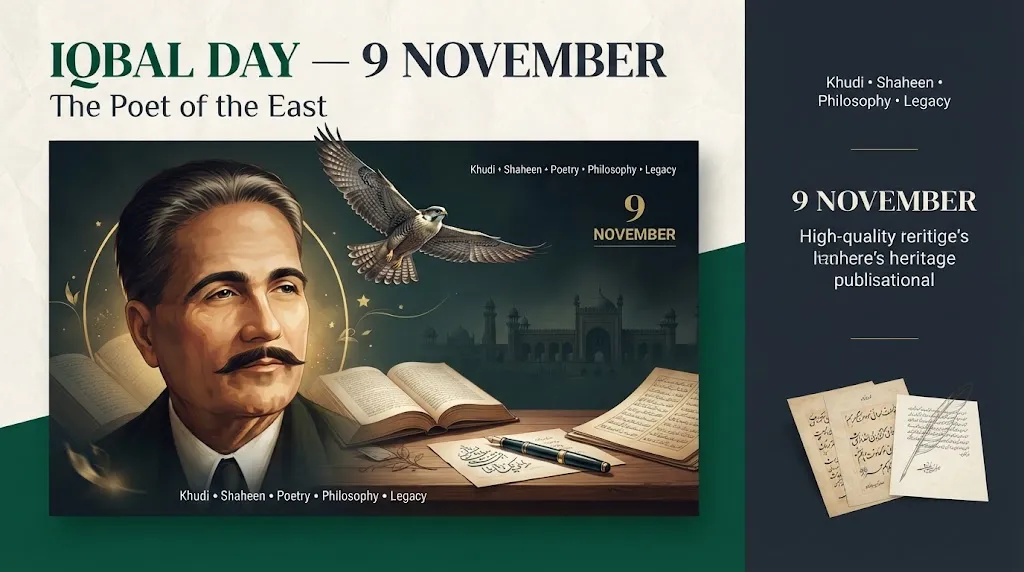
Iqbal Day 9 November: The Poet of the East — Inspirational Reflections, Blessings & Messages
Some commemorative days invite us simply to remember a person. Iqbal Day, 9 November, can invite something deeper: a moment to reflect on knowledge, character, courage, purpose, and the value of developing one’s inner potential.
Allama Muhammad Iqbal was born in Sialkot on November 9, 1877. He became internationally recognized as a poet and philosopher whose Urdu and Persian writings explored selfhood, spirituality, intellectual development, and collective life. The Iqbal Academy’s biographical material records his studies in South Asia and Europe and his development of Persian as an important language for his philosophical poetry.
For BlessMinty readers, this article approaches Iqbal Day from an inspirational perspective: alongside the history and literary context, you will find original reflections and blessings inspired by themes associated with Iqbal. These are not quotations by Iqbal.
1. Iqbal Day 9 November Blessings for Knowledge and Wisdom
Knowledge was central to Iqbal’s intellectual world. His own education crossed Sialkot, Lahore and Europe, where he studied philosophy and completed advanced academic work.
May these reflections encourage a lifelong love of learning.
- May your search for knowledge always lead you toward greater wisdom.
- May every lesson you learn make your heart more thoughtful and your character stronger.
- May curiosity keep your mind open to meaningful ideas.
- May education give you confidence without taking away humility.
- May your questions lead you toward understanding rather than confusion.
- May every book you read open a new door in your thinking.
- May knowledge become a source of service, not merely achievement.
- May you have the courage to learn from traditions different from your own.
- May wisdom help you distinguish information from understanding.
- May your education strengthen both your intellect and your character.
- May every teacher who guides you leave a positive mark on your journey.
- May you never become too proud to learn something new.
- May your knowledge help you make thoughtful decisions.
- May your learning continue long after formal education ends.
- May your pursuit of wisdom bring greater purpose to your life.
2. Iqbal Day 9 November Blessings for Khudi and Self-Development
Khudi, often translated as selfhood, is one of the central concepts associated with Iqbal’s philosophical poetry. Asrar-i-Khudi specifically explores this theme.
- May you discover your strengths without losing humility.
- May you understand yourself before trying to impress others.
- May your identity grow from principles rather than appearances.
- May you become stronger through discipline and reflection.
- May you recognize abilities that you have not yet developed.
- May your confidence be grounded in character.
- May you learn from failure without allowing it to define you.
- May you have the courage to become the person you are capable of becoming.
- May your ambitions remain connected to meaningful values.
- May you protect your individuality while respecting others.
- May self-knowledge bring you greater emotional balance.
- May every challenge reveal another layer of your strength.
- May you choose purpose over temporary approval.
- May personal growth make you more compassionate, not merely more successful.
- May your journey toward self-understanding remain honest and courageous.
3. Iqbal Day 9 November Blessings for Students and Young People
Iqbal’s writings frequently addressed education, youth, character and aspiration. His poetry remains widely used in educational and commemorative settings.
- May every student discover a reason to keep learning.
- May young minds remain brave enough to ask difficult questions.
- May education turn uncertainty into possibility.
- May every young person recognize the value of character.
- May students choose perseverance when progress feels slow.
- May your dreams become plans supported by disciplined action.
- May you never confuse temporary failure with permanent defeat.
- May your education prepare you to contribute to your community.
- May young hearts remain hopeful during difficult seasons.
- May every student find mentors who encourage growth.
- May ambition be guided by wisdom.
- May youth become a season of discovery rather than fear.
- May your talents develop through consistent effort.
- May your confidence grow from preparation.
- May every young person believe that meaningful contribution begins with small actions.
4. Iqbal Day 9 November Blessings for Courage and Resilience
Courage Is A Recurring Theme in interpretations of Iqbal’s thought. His famous Shaheen symbol is commonly associated with aspiration, independence and energetic striving.
- May courage meet you whenever fear appears.
- May difficult moments reveal your resilience.
- May you stand firmly for what you believe is right.
- May setbacks teach you without breaking your spirit.
- May you keep moving when the path becomes uncertain.
- May patience strengthen your courage.
- May you face challenges with wisdom rather than panic.
- May every difficult chapter deepen your character.
- May you find strength when circumstances test you.
- May fear never become the permanent author of your decisions.
- May your courage remain guided by compassion.
- May you recover from disappointment with renewed purpose.
- May adversity become an opportunity for growth.
- May you remember your progress when today’s challenge feels overwhelming.
- May your resilience become a quiet source of strength for others.
5. Iqbal Day 9 November Blessings Inspired by the Shaheen
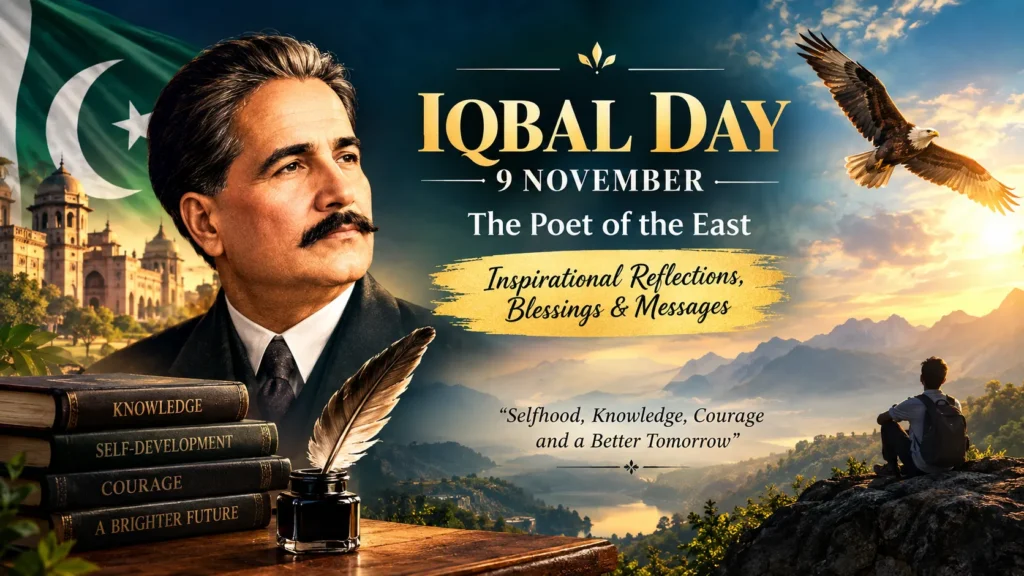
The Shaheen is one of the most recognizable symbols in Iqbal’s poetry. It is often interpreted through ideas such as independence, high aspiration and freedom from excessive attachment to comfort.
- May you always have the courage to aim higher.
- May your dreams rise beyond the limits of fear.
- May you value freedom of thought and responsible action.
- May comfort never prevent you from pursuing meaningful goals.
- May your aspirations remain connected to purpose.
- May you rise above discouragement with patience.
- May you develop the strength to travel your own path.
- May you never measure your potential by someone else’s expectations.
- May every challenge teach you how to rise again.
- May your ambitions inspire constructive action.
- May independence come with responsibility.
- May you remain brave without becoming careless.
- May your vision be higher than temporary obstacles.
- May your journey be guided by courage and wisdom.
- May you become an example of purposeful aspiration.
6. Iqbal Day 9 November Blessings for Faith and Spiritual Growth
Iqbal’s intellectual and poetic work was deeply engaged with Islamic thought, spirituality and moral questions. His Reconstruction of Religious Thought in Islam developed ideas through a series of lectures later published as a book.
- May faith bring steadiness to your heart.
- May spiritual reflection give meaning to difficult experiences.
- May your relationship with God deepen through sincere reflection.
- May your beliefs encourage compassion toward others.
- May prayer bring peace when circumstances feel uncertain.
- May faith strengthen your patience.
- May spiritual growth make your character gentler.
- May you seek wisdom as well as certainty.
- May gratitude accompany your success.
- May humility accompany your knowledge.
- May your spiritual journey remain sincere and thoughtful.
- May hope remain present during difficult seasons.
- May your actions reflect the values you hold dear.
- May your faith encourage service and kindness.
- May your heart find peace through purposeful living.
7. Iqbal Day 9 November: Blessings for Hope and Purpose
Iqbal’s work continues to attract readers partly because it asks questions about human potential and meaningful action.
- May you always have a reason to hope.
- May uncertainty never erase your sense of purpose.
- May tomorrow give you another opportunity to begin.
- May your goals become clearer with each step.
- May hope help you endure temporary difficulties.
- May you discover purpose in ordinary acts of service.
- May your dreams remain alive through disciplined effort.
- May disappointment redirect you toward something meaningful.
- May your future be shaped by wisdom rather than fear.
- May every new morning remind you that growth takes time.
- May you find purpose beyond material achievement.
- May your efforts contribute to something larger than yourself.
- May hope make you patient with your own progress.
- May your journey become meaningful even before you reach the destination.
- May purpose give your daily actions greater significance.
8. Iqbal Day 9 November Blessings for Gratitude and Contentment
Remembering A Literary Figure can become an opportunity to appreciate education, culture, language, teachers, and the people who shape our lives.
- May gratitude make ordinary moments feel meaningful.
- May you appreciate the people who helped you grow.
- May success never make you forget your beginnings.
- May every lesson become a reason for thankfulness.
- May gratitude bring peace to your daily life.
- May you recognize blessings that cannot be measured financially.
- May appreciation strengthen your relationships.
- May you remain thankful for opportunities to learn.
- May your heart notice beauty in simple moments.
- May gratitude soften difficult days.
- May you appreciate both progress and patience.
- May your achievements remind you of those who supported you.
- May thankfulness protect your heart from constant comparison.
- May you celebrate growth without becoming complacent.
- May gratitude become part of your everyday character.
9. Iqbal Day 9 November Blessings for Teachers and Mentors
Iqbal’s own intellectual development was shaped by teachers and scholars, including Sir Thomas Arnold. His biography records Arnold’s influence on Iqbal’s education and later decision to study in Europe.
- May every teacher be honored for the lives they influence.
- May mentors receive the appreciation they deserve.
- May teachers find patience when lessons become difficult.
- May educators continue inspiring curious minds.
- May every classroom become a place of discovery.
- May teachers have the wisdom to recognize different talents.
- May mentors guide without limiting individuality.
- May educators find renewed purpose in their work.
- May every student remember a teacher who believed in them.
- May knowledge passed from teacher to student continue across generations.
- May teachers be supported with respect and resources.
- May mentors receive encouragement as they encourage others.
- May educators remain lifelong learners.
- May teaching become a bridge between knowledge and character.
- May every sincere teacher leave a lasting positive legacy.
10. Iqbal Day 9 November Blessings for Family and Community
Iqbal’s work includes ideas concerning the relationship between individual development and collective life. His Rumuz-i-Bekhudi followed Asrar-i-Khudi and developed themes concerning the individual and community.
- May your family remain a source of encouragement.
- May homes be filled with patience and understanding.
- May differences become opportunities for respectful conversation.
- May family members celebrate one another’s growth.
- May communities become stronger through cooperation.
- May kindness cross boundaries of age and background.
- May every household make room for learning.
- May compassion guide difficult conversations.
- May families teach children both confidence and responsibility.
- May neighbors support one another during hardship.
- May community success include care for vulnerable people.
- May respect remain at the center of relationships.
- May shared values bring people closer.
- May generosity become a natural part of community life.
- May every family contribute something positive to the world around it.
11. Iqbal Day 9 November Blessings for Peace and Emotional Well-Being
A meaningful commemoration does not need to be loud. Sometimes remembering a great thinker creates a quiet space for reflection.
- May your mind find moments of stillness.
- May your heart have room to breathe.
- May you release worries you cannot control.
- May reflection help you understand your emotions.
- May difficult thoughts become easier to organize.
- May supportive people surround you when life feels heavy.
- May you permit yourself to rest.
- May patience replace unnecessary pressure.
- May peaceful moments restore your perspective.
- May kindness toward yourself accompany your personal growth.
- May you find healthy ways to process disappointment.
- May hope return after emotionally difficult days.
- May your daily routine include moments of gratitude.
- May meaningful connections strengthen your emotional well-being.
- May inner peace grow through purposeful and balanced living.
12. Iqbal Day 9 November Blessings for Personal Growth
Iqbal’s philosophy provides fertile ground for reflecting on growth, responsibility and potential.
- May you become wiser without losing your sense of wonder.
- May every mistake become a lesson.
- May discipline help transform intention into achievement.
- May your weaknesses become areas for thoughtful improvement.
- May you continue developing skills that serve a meaningful purpose.
- May personal growth remain a lifelong journey.
- May you welcome constructive criticism.
- May your goals become more mature as you gain experience.
- May you choose progress over perfection.
- May patience accompany ambition.
- May you recognize how far you have already come.
- May your character grow alongside your achievements.
- May your choices reflect your deepest values.
- May every challenge strengthen your ability to adapt.
- May growth make you more useful, thoughtful, and compassionate.
13. Iqbal Day 9 November Blessings for National and Cultural Heritage
Iqbal Occupies An Important Place In Pakistan’s literary and cultural history. Pakistani public institutions continue to commemorate his birth anniversary and refer to him as the Poet of the East.
- May cultural heritage be preserved for future generations.
- May young people discover the literature of their heritage.
- May languages continue carrying wisdom across generations.
- May history be studied with curiosity and honesty.
- May cultural pride encourage learning rather than division.
- May literary traditions remain accessible to young readers.
- May historical figures be understood in their full context.
- May museums, libraries and archives continue preserving cultural memory.
- May poetry remain a bridge between generations.
- May students explore heritage through original sources.
- May cultural celebrations encourage thoughtful learning.
- May literature connect people across geographical boundaries.
- May important historical sites receive careful preservation.
- May future generations continue discovering Iqbal’s writings.
- May cultural remembrance inspire constructive work in the present.
14. Iqbal Day 9 November Blessings for Meaningful Action
Iqbal’s philosophy can be approached not only through ideas but also through the relationship between thought and action.
- May your intentions become meaningful actions.
- May you turn knowledge into something useful.
- May your dreams receive the discipline they require.
- May each day contain one purposeful step forward.
- May you act with courage when action is needed.
- May thoughtful planning guide your ambitions.
- May your talents benefit people beyond yourself.
- May you choose consistency over occasional bursts of motivation.
- May your actions reflect your principles.
- May you transform obstacles into opportunities for learning.
- May small efforts accumulate into meaningful achievements.
- May you have patience with long-term goals.
- May your work contribute to something worthwhile.
- May your decisions be guided by wisdom and responsibility.
- May your life demonstrate the values you admire.
15. Iqbal Day 9 November Blessings for the Future
The most meaningful way to remember a historical thinker may be to ask what lessons can responsibly be carried forward.
- May the future be shaped by educated and thoughtful minds.
- May young people inherit hope rather than fear.
- May knowledge continue to cross cultural boundaries.
- May courage be balanced by compassion.
- May personal ambition remain connected to social responsibility.
- May future generations read history with curiosity.
- May literature continue encouraging reflection.
- May education remain accessible to those seeking opportunity.
- May communities invest in young minds.
- May wisdom guide technological and social change.
- May people preserve valuable traditions while remaining open to learning.
- May future leaders value character alongside achievement.
- May hope remain stronger than temporary setbacks.
- May every generation add something meaningful to the legacy it receives.
- May the lessons we remember today inspire constructive action tomorrow.
Why Is Iqbal Day Celebrated on 9 November?
The central reason is simple: November 9 is associated with Allama Muhammad Iqbal’s birth anniversary.
The Iqbal Academy biography identifies Iqbal as having been born in Sialkot on November 9, 1877.
Pakistan’s official and institutional calendars also list Allama Iqbal Day on Monday, November 9, 2026. The Pakistan Stock Exchange’s 2026 calendar lists it as a one-day holiday, while government diplomatic missions also list the date.
There is also an important historical nuance: some scholarship has discussed documentary questions surrounding the exact birth date. A 2025 Dawn report reviewed this issue and noted evidence supporting November 9, 1877 while discussing limitations in the municipal record.
For ordinary Iqbal Day educational content, however, November 9, 1877 is the date used by Iqbal’s official biographical materials and Pakistani institutions.
Who Was Allama Muhammad Iqbal?
Allama Muhammad Iqbal was a poet, philosopher, scholar, lawyer and political thinker.
His intellectual journey crossed several educational environments. The Iqbal Academy biography records his studies in Sialkot and Lahore, followed by Cambridge, a doctorate at Munich, and a legal qualification in London.
His literary legacy developed in both Urdu and Persian.
The move toward Persian became especially important when Iqbal began using Persian as a major vehicle for philosophical expression. Asrar-i-Khudi became one of the defining works of this period.
His major works include:
- Asrar-i-Khudi
- Rumuz-i-Bekhudi
- Payam-i-Mashriq
- Bang-i-Dara
- Zabur-i-Ajam
- Javid Nama
- Bal-i-Jibril
- Zarb-i-Kalim
- Armaghan-i-Hijaz
- The Reconstruction of Religious Thought in Islam
The International Iqbal Society also documents his major literary works and their themes.
Why Is Iqbal Called the Poet of the East?
“Poet of the East” is a widely used title for Iqbal, particularly in Pakistani public and cultural discourse. Radio Pakistan used the title in its coverage of Iqbal Day in 2025, while Pakistan’s Senate also used it when commemorating his birth anniversary.
The title reflects the breadth of his poetic and intellectual contribution across Urdu and Persian and his engagement with questions of spirituality, philosophy, identity, education and society.
His work also crossed geographical boundaries. His writings have been translated into numerous languages, allowing readers outside South Asia to encounter his ideas.
What Does Khudi Mean in Iqbal’s Philosophy?
Khudi is commonly translated as selfhood.
It should not be reduced to ordinary selfishness or egotism.
In Iqbal’s philosophical poetry, particularly Asrar-i-Khudi, the concept concerns the development of a purposeful and strong self. The International Iqbal Society specifically identifies Asrar-i-Khudi as a work discussing the philosophy of Khudi.
For a modern reader, the concept can be explored through questions such as:
- What are my genuine strengths?
- What responsibilities come with those strengths?
- Am I developing my abilities?
- Do my ambitions have a meaningful purpose?
- Am I allowing fear or passivity to control my decisions?
- How can personal growth benefit other people?
That makes Khudi particularly suitable for reflective and educational discussions.
What Does the Shaheen Represent?
The Shaheen is a recurring symbol in Iqbal’s poetry.
It is commonly discussed in connection with:
- aspiration
- independence
- courage
- movement
- self-respect
- freedom
- high ideals
Rather than treating the bird as merely decorative imagery, readers can explore it as part of Iqbal’s broader symbolic language concerning human potential.
For students, the Shaheen can therefore become a useful starting point for discussions about ambition, discipline and responsible independence.
What Was the Allahabad Address?
On December 29, 1930, Iqbal delivered his presidential address at the annual session of the All-India Muslim League in Allahabad.
The address became an important document in the intellectual history surrounding Muslim political thought in British India.
Radio Pakistan’s historical coverage identifies the 1930 Allahabad Address as an important part of Iqbal’s political legacy.
It is important to maintain historical precision: Iqbal died in 1938, while Pakistan was established in 1947. His ideas subsequently became closely associated with the intellectual history of Pakistan.
Iqbal’s Major Literary Works at a Glance
| Work | Language | Main relevance |
| Asrar-i-Khudi | Persian | Khudi/selfhood |
| Rumuz-i-Bekhudi | Persian | Individual and collective life |
| Payam-i-Mashriq | Persian | Eastern intellectual response |
| Bang-i-Dara | Urdu | Major Urdu poetry collection |
| Zabur-i-Ajam | Persian | Philosophical poetry |
| Javid Nama | Persian | Philosophical/spiritual journey |
| Bal-i-Jibril | Urdu | Mature Urdu poetry |
| Zarb-i-Kalim | Urdu | Social, political and cultural themes |
| Armaghan-i-Hijaz | Urdu/Persian | Late poetic work |
| Reconstruction of Religious Thought in Islam | English | Religious/philosophical thought |
The Iqbal Academy and International Iqbal Society provide bibliographic and biographical information about these works.
Famous Iqbal Poems and Literary Themes
Some widely recognized works and poems associated with Iqbal include:
- Lab Pe Aati Hai Dua
- Tarana-e-Hindi
- Shikwa
- Jawab-e-Shikwa
- Khizr-e-Rah
- Bang-i-Dara
- Bal-i-Jibril
- Zarb-i-Kalim
- poetry concerning the Shaheen
- poetry concerning Khudi
- poems addressing youth and education
A useful editorial rule for BlessMinty is to avoid presenting unattributed internet quotations as authentic Iqbal quotations. When publishing quotations, use a reliable edition or authoritative Iqbal resource and provide the work title.
That approach strengthens both reader trust and EEAT.
How Can Students Celebrate Iqbal Day?
Iqbal Day can become more meaningful when students actively engage with his work rather than simply memorizing biographical facts.
Useful activities include:
- Read one poem and discuss its central idea.
- Prepare an Iqbal Day speech.
- Create a timeline of Iqbal’s life.
- Study the concept of Khudi.
- Research the Shaheen symbol.
- Explore the Allahabad Address.
- Hold a poetry recitation.
- Create a classroom exhibition.
- Compare Urdu and English translations.
- Research Iqbal’s European education.
- Visit an Iqbal museum or historical site where practical.
- Prepare a short biography.
- Discuss the relationship between knowledge and character.
- Create original artwork inspired by Iqbal’s themes.
- Write a personal reflection on one lesson learned from his work.
Iqbal Day 2026: Date and Holiday Information
Iqbal Day 2026 will fall on Monday, November 9.
The Pakistan Stock Exchange’s official 2026 holiday calendar lists Allama Iqbal Day — Monday, November 9, 2026.
Government holiday calendars published by Pakistani diplomatic missions also list November 9, 2026 as Allama Iqbal Day.
Because holiday arrangements can be modified through official notifications, readers making employment, school, or travel plans should verify the latest applicable government notification.
Why Iqbal’s Message Still Resonates
Iqbal’s continuing relevance does not depend on reducing his work to a handful of motivational quotations.
His writings invite deeper questions:
How should a person develop their abilities?
What is the relationship between individuality and community?
How should education shape character?
What role should courage play in human development?
How can spiritual values coexist with intellectual inquiry?
These questions help explain why Iqbal remains a subject of literary, philosophical, educational, and historical discussion.
His biography also demonstrates an unusual intellectual journey: education in South Asia, advanced study in Europe, legal training, literary production in Urdu and Persian, philosophical writing and political engagement.
Quick Reference: Iqbal Day 9 November
| Question | Answer |
| What is Iqbal Day? | The annual commemoration associated with Allama Iqbal’s birth anniversary |
| When is Iqbal Day? | November 9 |
| When was Iqbal born? | November 9, 1877, according to official Iqbal biographical material |
| Where was he born? | Sialkot |
| When did he die? | April 21, 1938 |
| Where did he die? | Lahore |
| What is he known as? | Poet of the East / Shair-e-Mashriq |
| What is Khudi? | A central philosophical concept commonly translated as selfhood |
| What is the Shaheen? | A recurring symbolic figure in Iqbal’s poetry |
| What was the Allahabad Address? | A major political address delivered by Iqbal in 1930 |
| What languages did he write in? | Primarily Urdu and Persian poetry, with important English prose |
| When is Iqbal Day 2026? | Monday, November 9, 2026 |
The official Iqbal biography and 2026 institutional calendars support the principal dates above.
People Also Ask About Iqbal Day
Why is 9 November called Iqbal Day?
November 9 is observed as Iqbal Day because it commemorates the birth anniversary of Allama Muhammad Iqbal, who is recorded by the Iqbal Academy as having been born in Sialkot on November 9, 1877.
Who is the Poet of the East?
Allama Muhammad Iqbal is widely known as the Poet of the East or Shair-e-Mashriq. Pakistani institutions regularly use this title when commemorating him.
What is Iqbal’s most important philosophy?
One of his most prominent philosophical concepts is Khudi, commonly translated as selfhood. It is particularly developed in Asrar-i-Khudi.
What is Iqbal famous for?
Iqbal is remembered for his Urdu and Persian poetry, philosophical writing, political thought and influence on Muslim intellectual discourse in British India.
What does Shaheen mean in Iqbal’s poetry?
The Shaheen is a recurring symbol associated with qualities such as aspiration, courage, independence, and purposeful striving.
Conclusion
Iqbal Day 9 November, is an opportunity to remember Allama Muhammad Iqbal while also exploring the ideas behind his enduring literary legacy.
Born in Sialkot on November 9, 1877, Iqbal developed a body of work spanning Urdu and Persian poetry, philosophy, religious thought, and political ideas. His major works include Asrar-i-Khudi, Rumuz-i-Bekhudi, Bang-i-Dara, Javid Nama, Bal-i-Jibril and Zarb-i-Kalim.
His association with Khudi, the symbolism of the Shaheen, his philosophical writings and his 1930 Allahabad Address remain important subjects for readers and students.
But remembering Iqbal does not have to end with a date, a quotation or a school speech.
It can become an opportunity to learn something new, strengthen character, appreciate knowledge, reflect on purpose, and turn inspiration into constructive action.
On Monday, November 9, 2026, Iqbal Day will again provide an opportunity to revisit the life and work of the man widely remembered as the Poet of the East.
May the day encourage us not merely to remember meaningful words, but to read them carefully, understand them honestly, and live their positive lessons thoughtfully.